

From the imposing astronomical clocks of Tudor England to the exquisite pendant watches of Victorian Britain, timekeeping has long been a symbol of power, prestige, and technological marvel within Europe’s royal courts. This new series explores the fascinating evolution of clocks and watches crafted specifically for royalty, tracing how these intricate masterpieces reflected the tastes, ambitions, and innovations of monarchs. Through the lens of craftsmanship, artistry, and historical significance, we reveal how these royal timepieces marked the passage of dynasties and empires.
Victoria (1819-1901) was the queen of the United Kingdom of Great Britain and Ireland between 1837 and 1901 and empress of India from 1876 to 1901. She was the last monarch of the House of Hanover and a queen whose reign defined an age known as the Victorian Era. It was a period of immense change and expansion that shaped Britain and the modern world. Under her rule, the monarchy evolved into the symbolic, ceremonial institution it is today.
Victorian Britain was the workshop of the world, a place where science, engineering and artistry converged to define a new age of progress. From railways and telegraphs to the marvels of the Great Exhibition, innovation pulsed at the heart of empire. In horology, too, Britain played a commanding role with its precision chronometers keeping the navy supreme, while its watchmakers and clockmakers set standards of craftsmanship that resonated across Europe.
Into this world of exacting science and exquisite design stepped Queen Victoria and Prince Albert, whose patronage elevated timepieces from functional instruments into symbols of modernity, refinement and power.

Portrait of Queen Victoria by Franz Xaver Winterhalter, c.1859. Royal Collection RCIN 405131. Public Domain
Punctuality was prized as a virtue, and the watch became a vital accessory for both aristocrats and the rising middle class. Queen Victoria’s own interest in watches, gifts exchanged with Prince Albert and treasured family heirlooms, helped popularize the personal timepiece as a symbol of status and affection.
The Empress of an Industrial Age
Victoria ascended to the throne in 1837 and ruled for over six decades, presiding over an era that witnessed the British Empire’s greatest expansion and the dramatic upheaval of the Industrial Revolution. For Victoria, timekeeping was more than a convenience; it was a symbol of the orderly, moral society she championed.

Early steam locomotive arriving at Paddington Station in London. Image courtesy of the National Archives
During Queen Victoria’s reign, railways symbolised progress and industrial might, physically shrinking distances and altering society by allowing for mass travel, quicker transportation of goods, the growth of cities, and a new era of leisure. They represented a fundamental shift in modern life, making the country more connected and facilitating social and economic expansion.
Before the railways, every town in Britain kept its own local time, based on the position of the sun. For example, noon in Bristol was about 10 minutes behind noon in London. Railway companies needed a single, standardised time so that timetables would be reliable, and trains wouldn’t collide on single-track lines. Each company originally used its own time standard, but this quickly became unworkable. The solution was to adopt London time, measured by the Royal Observatory at Greenwich (what we now call Greenwich Mean Time or GMT). The Great Western Railway was the first to use a unified ‘Railway Time’ which began in 1840.

First world postal stamp ever issued, the Penny Black, Great Britain, 1840. Public Domain
Also in 1840, the first postage stamp, known as the Penny Black, was introduced. It democratised communication and became one of the first icons of modern mass society. The first stamp (above) featured a profile of Queen Victoria and cost just one penny to send a letter anywhere in Britain. Its success transformed communication, making letter writing accessible to all and turned the Queen’s image into one of the most widely recognized symbols of the Victorian age.
The Great Exhibition of 1851 – A Watershed for Watchmaking
The Great Exhibition – full title ‘Great Exhibition of the Works of Industry of All Nations’ – of 1851 may have been a celebration of Victorian industry, but for horology it represented something more intimate, namely, the moment that Swiss makers publicly rivaled and, in many respects, surpassed traditional English dominance.
Patek Philippe displayed keyless winding watches, a new innovation that freed a watch from the awkward key and made jeweled pendant watches more wearable and elegant for ladies’ fashion. Edward Dent & Co exhibited huge precision marine and turret clocks; Charles Frodsham & Co showed regulators and chronometers from the English tradition.

The Opening of the Great Exhibition by Queen Victoria on 1 May 1851 by Henry Courtenay Selous. Courtesy of the V&A
Quote: “This day is one of the greatest and most glorious of our lives. The Sun shone and gleamed upon the gigantic edifice. The tremendous cheering, all this was indeed moving.”
An entry from Queen Victoria’s diary about opening the Great Exhibition Crystal Palace at Hyde Park in central London.
Dent went on to build the movement for the Great Clock of Westminster (otherwise known as ‘Big Ben’), which was installed in 1859. For a maker, a royal purchase was the ultimate validation. For the public, a sketch of the Queen wearing a small, enameled pendant watch or a photograph of a Balmoral drawing room with a Dent clock on the mantelpiece made the object desirable and fashionable. The net effect was to turn what had once been a male-oriented tool of navigation and science into an item of domestic taste and jewelry.
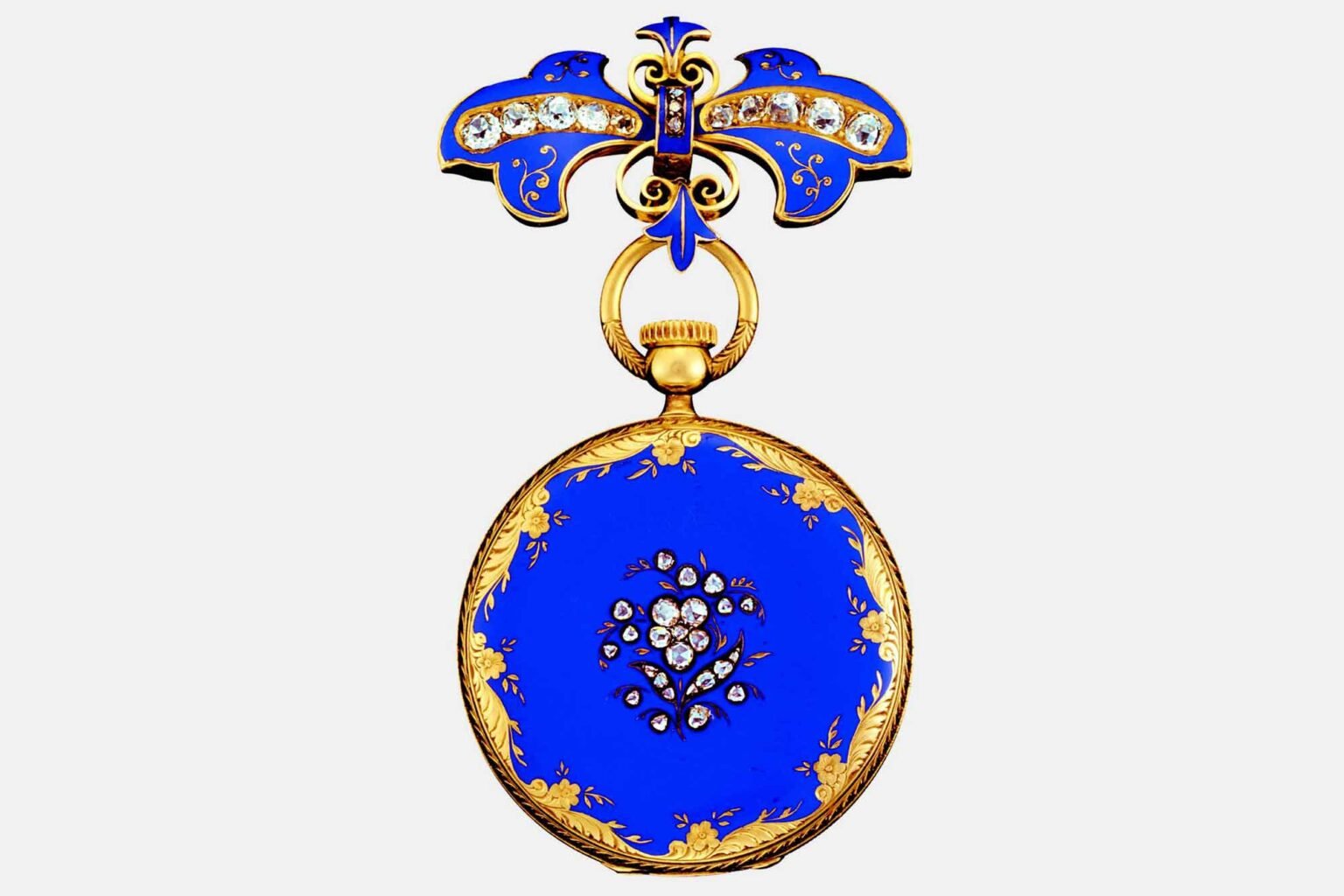
According to the Patek Philippe Archives, Queen Victoria purchased watch No. 4710 (below), a striking azure-blue pendant watch adorned with diamonds, on the 30th of November, for CHF612.50 (approx. CHF75,000 today). The Queen first came across the piece at the Great Exhibition, where she was immediately captivated by its elegance.

Blue enamel and diamond pendant watch purchased by Queen Victoria in 1851. Image courtesy Patek Philippe
Interestingly, this was not Queen Victoria’s first Patek Philippe. According to the records held at Patek Philippe, earlier that year, on August the 9th, she purchased watch No. 3218, a quarter-repeating, hunting-cased pocket chronometer, for Prince Albert, at a cost of CHF 1325 (approx. CHF 143,000 today). The whereabouts of this remarkable timepiece are now unknown, but the movement below is of a similar pocket watch made at the time by Patek Philippe.

Movement of an 18k gold quarter repeating key wind and key set pocket watch by Patek Philippe, c.1851
The Great Exhibition of 1851 was a landmark moment that showcased the full scale of Victorian ambition, innovation, and global reach. It brought together over 100,000 exhibits from dozens of countries, celebrating industrial progress, scientific achievement, and artistic craftsmanship under the iconic glass-and-iron Crystal Palace in London’s Hyde Park.
This exhibition-grade clock-watch by Alexander Watkins, was made specifically for the Great Exhibition of 1851. It has a gold watch case that is profusely engraved. The four-coloured gold dial has a day-of-the-month dial, with steel hands. The movement is of eight-day duration with quarter-striking as well as repeating on 5 gongs and has a spring-detent escapement.

Watch made for the 1851 Great Exhibition by Alexander Watkins, London, 1851. Science Museum Group/The Clockmakers’ Museum © The Board of Trustees of the Science Museum
The backplate is profusely engraved and signed ‘Alexr. Watkins, City Road 1851. London’. The inscription printed on silk inside the outer box reads ‘GRAND EXHIBITION OF ALL NATIONS’ and is on display at the Clockmakers’ Museum in South Kensington, London.
Beyond its immediate spectacle, the Exhibition standardised industry, inspired technological advancements, and boosted Britain’s cultural confidence. The profits of £186,000 (£22.6m today) generated were used to fund lasting institutions for science, art, and education in South Kensington — what came to be known (and still is today) as ‘Albertopolis’ after Prince Albert, who spearheaded the Exhibition.
The funds helped establish the South Kensington Museums (see below), which evolved into, the Victoria and Albert Museum (V&A), Science Museum and Natural History Museum. Land was also purchased for the Royal Albert Hall. The proceeds supported scholarships and educational initiatives in science and the arts.

Legacy of the Great Exhibition
Royal Patronage and Innovation
Following on from the Great Exhibition, Victoria continued to purchase clocks and watches. After her visit to Paris in 1855, she purchased at least five ornate mantel clocks made by leading French firm Miroy Frères (see below). One such piece with a hunting theme is recorded as chosen for Balmoral Castle in Scotland.

Gilt-bronze mantel clock by Miroy Frères, Paris, c.1855
During Queen Victoria’s reign, the modern system of awarding Royal Warrants matured. A Royal Warrant under Queen Victoria was the horological equivalent of a ‘golden ticket’. It meant a firm could proudly advertise itself as ‘Watchmaker (or Clockmaker) to the Queen’. Warrants were formalised with specific rules on displaying the royal coat of arms on products, labels, and shopfronts.
Notable warrant-holders included:
- Patek Philippe — secured Victoria’s patronage after the 1851 Exhibition; her enamel pendant watch became one of the firm’s most famous royal commissions.
- Breguet — supplied elegant pieces to both Victoria and Albert, including a ring watch No. 5102, purchased in 1838 (see purchase record below).
- E. J. Dent & Co — renowned for chronometers, domestic clocks, and, posthumously, the mechanism for the Great Clock at Westminster (Big Ben).
- Charles Frodsham & Co — one of the most respected English horologists, appointed ‘Clockmaker to the Queen’ in 1854.
- Nicole & Capt — a Swiss-run London firm and masters of complications.
- Vulliamy & Sons — the long-established London clockmaking dynasty, official clockmakers to the Crown.

Breguet purchase record for Queen Victoria’s ring watch in 1838. Image courtesy of Montres Breguet
Comment from the Breguet archives. Victoria, Queen of Great Britain and Ireland, purchased a Breguet watch on July 17 1838, a year after her accession to the throne. It was “a very small and simple watch, without repeater, very thin, for a ring” registered under number 5102.

Wall mounted regulator clock by Frodsham bearing the statement ‘Clock Maker to the Queen’ on the dial, c.1880. Image courtesy of Charles Frodsham & Co
Those watch and clockmakers fortunate enough to receive the Royal Warrant were able to state this fact on their watches and clocks. The wall-mounted regulator clock by Charles Frodsham & Co above has the phrase ‘Clock Makers to the Queen’ clearly displayed on the dial of the clock.
The Dawn of Modern Timekeeping
Victoria’s reign set the stage for the modern wristwatch and the global synchronisation of time. The Victorian obsession with order and progress fostered innovations that continue to influence horology today.
As the monarch of a time-conscious society, Victoria embodied an era when the mastery of time became inseparable from the mastery of empire and identity.
Under Queen Victoria, the watch transformed from a luxury to a necessity, an intimate companion that measured moments both public and private. Through her patronage and personal example, Victoria helped usher in an age where timekeeping defined the rhythm of life, industry, and empire.
The post A Majestic Journey Through Clocks & Watches Made for Royalty: The Victorian Age of Time – Queen Victoria and the Watchmaking Revolution appeared first on Worn & Wound.