

Christopher Ward introduced the C63 Sealander in 2021 as a go-anywhere, do-anything watch. It was meant to be the brand’s contemporary, bread-and-butter line: a less specialized variation of the C60 Trident diver that had long been its core, while avoiding vintage pastiche. The Sealander was simple, easy to digest, and versatile.
It was also, somewhat, a return to Christopher Ward’s original bang-for-your-buck ethos. When the C63 launched with a $695 three-hand automatic, it was a statement about the brand’s values, not just value. The GMT, meanwhile, started at $950 on a strap. Both offered a lot of Swiss-made mechanical watch for the money.
the Sealander in 2021
Fast-forward five years, and I don’t know if any watch brand has changed quite as much as Christopher Ward. The Bel Canto arrived in 2022 and totally reframed how the company was perceived. The Twelve followed in 2023 and raised the standard of its core watches. Then came the Twelve X, which put its in-house movements and finishing capability in the spotlight, and finally the Loco, which proved the Bel Canto was not a one-off. Christopher Ward was redefining what value could mean in the context of avant-garde independent watches.
As such, the brand that launched the C63 in 2021 is very different from the one releasing its replacement in 2026. It is bigger, has a much larger customer base, enjoys far greater awareness, and, frankly, has a better reputation. The new Sealander reflects that transformation, right down to the price. The three-hand automatic now starts at $1,150 on a strap, while the GMT starts at $1,395.
That is a substantial increase, so what has changed? Both very little and almost everything. The basic formula remains familiar, but the cases have been reproportioned, the dials and hands have been refined, and the bracelets introduce one of the most intuitive tool-free sizing systems I have used. The result is among the best, if not the best, Swiss-made mechanical watches under $2,000 if what you are looking for value. But that does come at a cost: personality.
The first change is conceptual. The Sealanders are no longer couched under the Trident line. That might seem insignificant, especially because the most obvious evidence is simply the removal of the signature trident counterweight from the seconds hand. But it marks the Sealander as a line unto itself, something also made explicit by the new “Sealander” logo on the dials.

I have seen some blowback about this because people like the trident, but distancing the Sealander from a family of dive watches makes sense. It lets both lines breathe and grow independently, and it makes the Sealander’s cleaner, more versatile character easier to understand on its own terms. But it also highlights one drawback of their approach to the Sealanders: they removed quirkier elements to create safer, but less unique, watches.
Review: the Christopher Ward Sealander – the Best Boring Watch Money Can Buy
Stainless Steel
Sellita SW200-2 or SW330-2
Various
Yes
Sapphire
Bracelet, Leather, Rubber
150m
36 or 39 or 42mm
11mm
20mm
Screw-down
Yes
$1200
Case
At a glance, the cases still look like the familiar Light-catcher design. In reality, they are entirely new and reproportioned. The easiest change to spot is that the midcase now extends beyond the bezel, making the wide polished bevel running along it more pronounced. That bevel catches the light more clearly and gives the case stronger definition without changing the overall visual language.
The three-hand models have also lost their crown guards, further distancing them from the original Trident-based design. This leaves the GMTs looking a little sportier by comparison. The GMT bezel has also been updated, with lines replacing dots in the index and a slightly more aggressive, angular typeface. The crowns are now subtly tapered, a small change that contributes to a more refined overall appearance.

None of these revisions radically alter the Sealander. Instead, they make the familiar form cleaner and more resolved. This is a recurring theme throughout the new collection: Christopher Ward has removed or softened small details while improving execution.
Dials
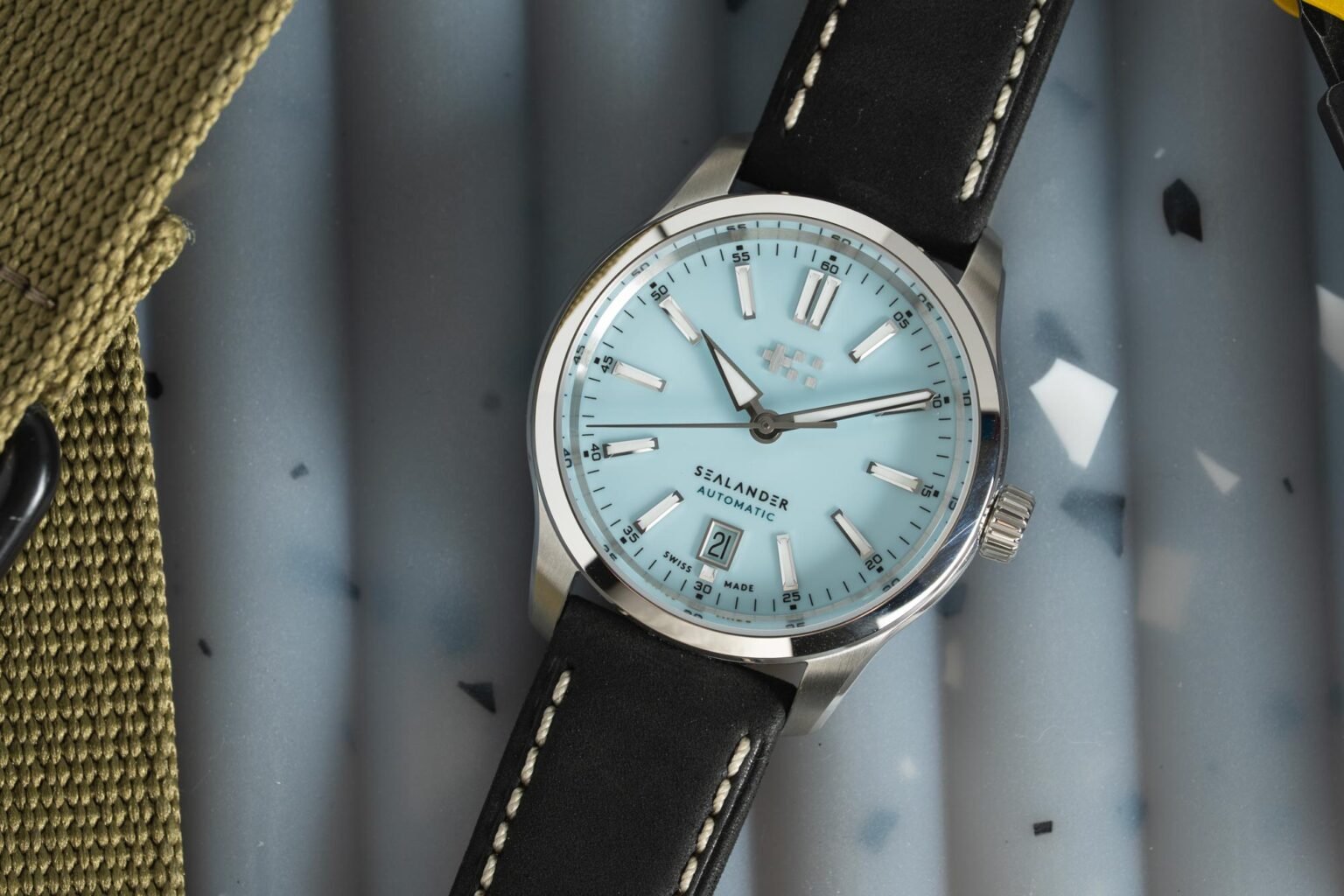
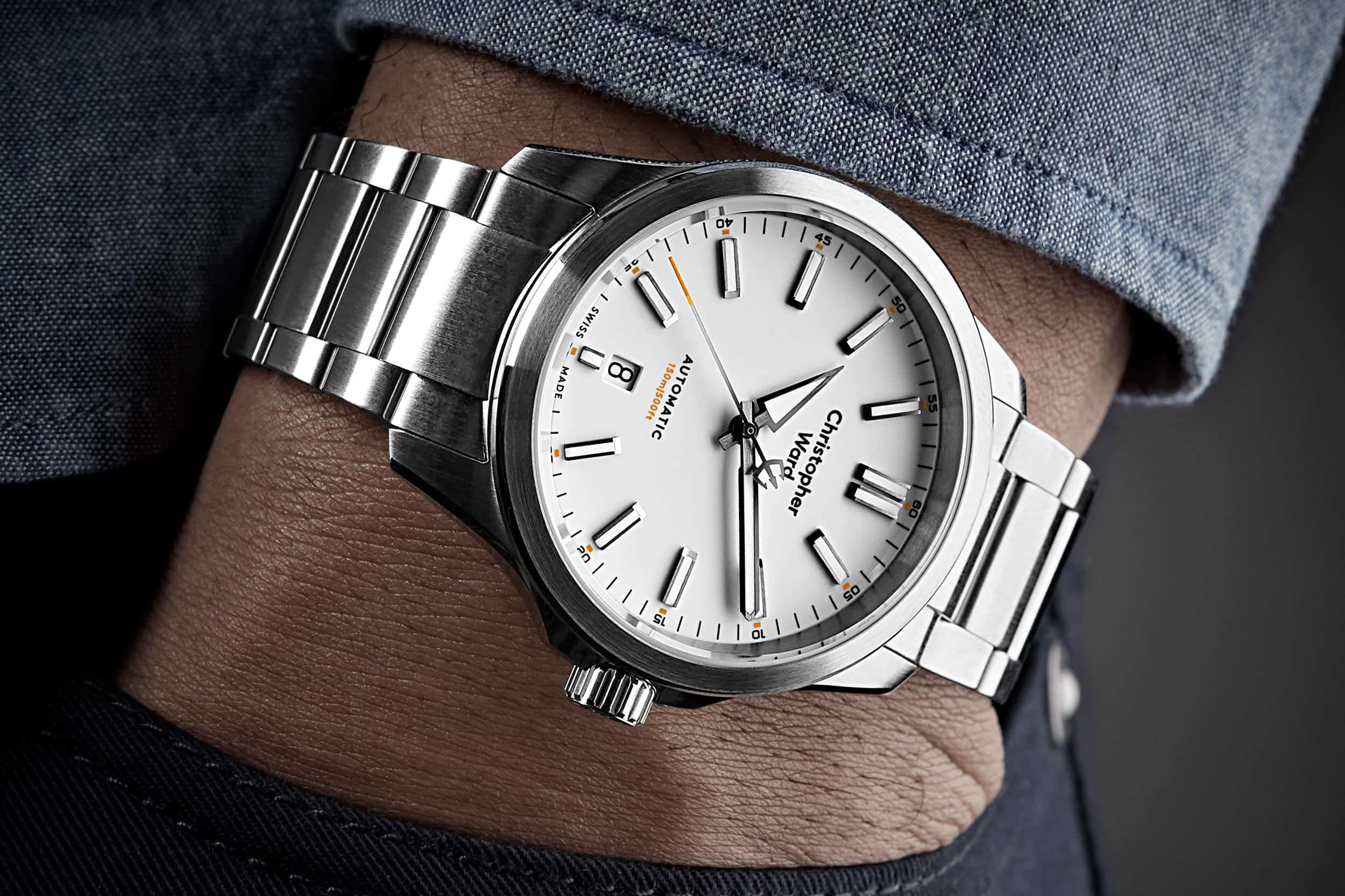
The dials follow the same strategy. They look very similar to those of the previous generation, yet nearly every element has been reconsidered. The date windows now have applied frames, the numerals around the outer edge have switched places with the dots beside them, and the dial surfaces are lacquered for a glossy sheen.

The GMTs have undergone a more substantial makeover. The numerals and dots on the outer index are gone entirely, and the hour markers now extend toward the edge. Removing those elements also lets Christopher Ward tone down the contrasting colors of the previous generation, creating a cleaner, if more conservative, look.
The applied markers have been completely redesigned and now taper gently toward the center of the dial. More impressively, they feature chamfers that cut through not only the metal, but the lume fill as well. I have never seen that before, and it looks impressive even under a loupe.

In fact, I recommend taking a loupe to these dials if you get the chance. They are exceptionally crisp. The polishing on the applied markers is immaculate, the glossy surfaces are even and spot-free, and the printing is sharp. Even the twin-flag logo, which consists of five tiny vertically brushed pieces, looks excellent up close.
The hands have been refined too. The minute hand, previously a straight sword, now pulls inward ever so slightly. Like the tapered crowns and hour markers, it adds a touch of elegance. On the previous Sealanders, both the hour and minute hands extended slightly past the center. They now stop at the pinion, which is less distinctive but cleaner. More importantly, the old hands were polished with brushed stripes running down their centers. That treatment always bothered me on the hour hand because it looked a bit messy and could even appear off-center. The new hands are faceted and fully polished. Again, they are a little less distinctive for better execution.

There are five dial colors at launch: white, black, sky blue, pistachio green, and pink. The lacquered white dial is very clean and crisp, accented with black printing, blackened metal appliques, and matching hands. It’s a touch aggressive and thoroughly modern. I didn’t have the white GMT, but I can imagine it looks excellen as well.
The Sky Blue is soft and pale. It is a nice blue, though a bit too gentle for my taste; I would prefer a navy or cobalt, something more classic. They did match the date disk to the dial, however, which is a nice touch. Pistachio is an apt name for the pale, creamy green they chose, and it also has a matched date disk. I am generally a fan of green dials, but this one does not quite click for me.
The color is pleasant, but not exciting, and the GMT hand doesn’t contrast enough. It feels almost noncommittal, as though it does not really want to be a GMT. The blue, green, and pink (not reviewed) were an odd choice for launch. They feel like seasonal, trendy versions of these colors, not core varieties. Unlike the black and white, I could see one getting tired of them.

The black GMT is exactly what you would expect: a gloss-black dial with polished silver indices and hands, save for the orange GMT hand, drawing on the classic Explorer II formula. These are different enough not to be homage watches, but the inspiration is clear. Regardless, the gloss black just looks so clean.
A New Standard for Bracelets
The most immediately useful improvement is not on the dial or case. It is the iLink system fitted to both of Christopher Ward’s bracelet options. Bad name, great system. While Christopher Ward is not the only brand offering a tool-free bracelet, this is possibly the best implementation I have experienced.

The removable links have an easy-to-identify button on one side. Push it, and the cap pops off. You can then pull the link out from the opposite side. Repeat as many times as needed, then snap the bracelet back together. It takes seconds.
The system is fast, easy, repeatable, and requires no special equipment. No tiny screws, pins, or collars to lose, no need to visit a watchmaker, and very little risk of scratching the bracelet. It is simple enough for someone with no experience handling watches. That’s how it should be.

Each Sealander comes with a choice of five strap and bracelet options, including the Bader and Consort bracelets. The Bader is a fully brushed three-link design with the classic, sporty Oyster look. Its fold-over locking clasp includes a built-in micro-adjust system that offers about 5.5mm of adjustment.
The five-link Consort is the dressier choice, mixing brushed and polished surfaces. Its shorter links also make it more flexible than the Bader. A hidden butterfly clasp keeps the appearance clean, while the links on either side of the clasp can expand to provide roughly 4mm of additional room when both are open.

Crucially, the iLink system works with both bracelets. I cannot tell you how many bracelets I have sized in my life, but I can tell you how many times I have enjoyed doing it: once, with these. Seriously, other brands should take note. A new bar has been set.
Movements
The Sealander collection is divided into two main categories: three-hand automatics and GMTs. The automatics come in 36mm and 39mm cases, while the GMTs come in 36mm, 39mm, and 42mm.
The three-hand models use the new Sellita SW200-2 Power Plus, which offers a 65-hour power reserve. The movements are lightly decorated and fitted with custom rotors. The expanded reserve is a meaningful everyday improvement over the previous generation, especially for a watch designed to be worn in rotation.

The GMTs continue to use the Sellita SW330-2. It is a caller GMT movement, meaning the 24-hour hand is independently adjustable rather than the local hour hand. It uses the same caliber as the prior generation and remains a good, reliable choice with a 56-hour power reserve.
Wearability
With five dial colors, three sizes, two movements, and five strap or bracelet options, there are many possible Sealanders at launch. I reviewed four watches covering both movements, all three case sizes, and four of the colors.
The 36mm automatic measures 42mm lug to lug and 11mm thick, with a 20mm lug width. I like a 36mm watch, especially one with 20mm lugs, because that combination has a classic, sporty Explorer feel, and this nails it. It doesn’t feel small or like it is trying to be vintage. Instead, it feels compact and solid. The Light-catcher case also does its job, breaking up the 11mm height so the watch reads thinner on the wrist.

The 39mm automatic measures 39mm by 45mm by 11.1mm. The 36mm to 39mm range is ideal for my 6.75-inch wrist, so both automatics wear very well. The 39mm model definitely feels and reads larger, but it remains an easy everyday watch.
Moving to the GMTs changes the visual equation. Their fixed 24-hour bezels reduce the dial opening, which significantly affects how the watches look and wear. The 39mm GMT measures 39mm by 44.7mm by 11.6mm, with 20mm lugs. Its footprint is almost identical to the 39mm automatic, although it is slightly thicker and feels a little more substantial because of its crown guards. On the wrist, however, it reads smaller than the 39mm automatic. It’s a sturdy, slightly muscular watch, and I quite like it.

The 42mm GMT is the outlier, measuring 42mm by 48.3mm by 11.7mm, with 22mm lugs. The wider lugs accentuate the step up from the 39mm, and this is unquestionably a big watch. I didn’t expect to like it because of its size, but it ended up being my favorite in the group.
The bezel visually compresses the watch and balances its larger dimensions, since the dial opening is only 34mm. The bracelet also tapers dramatically, from 22mm at the lugs to 16.5mm at the clasp, which lightens both its appearance and feel. The watch doesn’t wear small, but its proportions work, at least on my 6.75-inch wrist.

Perhaps I would choose the 39mm GMT if it also had the black dial, but during my time with the collection, the 42mm was the watch I most wanted to put on and the one I most enjoyed seeing on my wrist. Go figure.
Conclusion
So, what do I actually think about the new Christopher Ward Sealanders, and how do I say this without sounding like a jerk? I think they are some of the nicest versions of tame watches I have seen. They present no challenge whatsoever. I might even call them safe, and perhaps a touch boring, but in the best way possible.
Christopher Ward has answered the question, “What if I just want a damn good watch?” This is a versatile, everyday, jack-of-all-trades, master-of-none sort of watch. It does everything it needs to do and does it well, but it has no specialty. It focuses on quality of life and execution. It is the watch you can grab when you don’t know what you want to wear.

More importantly, Christopher Ward made watches that are hard not to like. Little about them could offend, but little is especially memorable too. The company did not set out to create a cult hit. That is what the Bel Canto and Loco are for. It wanted to create a watch that was easy to understand and, therefore, easy to sell.
That makes sense for the company Christopher Ward has become. It has grown tremendously over the last five years and now needs to appeal to a broader audience, including customers who sometimes just want a damn good watch. To that end, it removed some of the Sealander’s quirks: the trident counterweight, the elongated hands, and some of the contrasting colors. It also softened the design through repeated tapering, making the watches easier on the eyes.

What I respect is that Christopher Ward did all of that without cheapening the Sealander. Quite the opposite. The quality is improved throughout, especially on the dial, and the iLink system is genuinely impressive even if it is not an outward-facing feature. These watches do not merely compete with similarly priced offerings from big-group brands. Their exterior execution feels comparable to watches costing twice as much, perhaps even more. Longines, watch your ass.
There is, however, one bitter pill to swallow. These are no longer the budget-friendly Swiss-made watches they were when the original C63 launched. They remain very reasonably priced for what they are, but they have moved upmarket to meet a new customer. The days of Christopher Ward offering sub-$1,000 Swiss-made mechanical watches appear to be in the rearview mirror. Times change, I guess.

Christopher Ward still represents real value, but it is no longer primarily in the “my first watch” segment it once occupied. It is an accessible-luxury brand now, one the young collector I once was would have had to eventually step up to.
I will pour one out for the C5 Malverns and the C8 and C10 pilot watches we once reviewed, but I also take some comfort in knowing the price bracket Christopher Ward has left behind is not empty. In fact, more compelling sub-$1,000 brands than ever before exist, and I would rather see Christopher Ward take on the Swiss luxury brands that once dismissed it as not a threat. Christopher Ward
The post Review: the Christopher Ward Sealander – the Best Boring Watch Money Can Buy appeared first on Worn & Wound.