

Serena Williams has been playing professional tennis since 1995. In the decades since, she has won 23 Grand Slam singles titles, but perhaps more importantly, she has broken through barriers of race, age, and background while upending tennis’s traditional dress codes. Clothes, and by extension accessories, have always been part of that story. In 2022, New York Times chief fashion critic Vanessa Friedman called Williams “the game-changing tennis player” who used her clothes “as a statement of self and a weapon of change.”

Williams understood early on that what she wore on court could be another form of expression: sometimes provocative, sometimes playful. At the 2002 US Open, she broke conservative norms in a skin-tight black Puma catsuit, accessorized with a Harry Winston diamond bracelet. Seventeen years later, at the 2019 French Open, she wore a Nike look designed by Virgil Abloh for Off-White printed with the words “Mother, Champion, Queen, Goddess” in French, an especially pointed choice given that, just a year earlier, the tournament had taken issue with the black Nike catsuit she wore on court.

Serena Williams at the 2024 Met Gala, wearing an Audemars Piguet Sandgold Royal Oak Flying Tourbillon Openworked .
That influence has extended far beyond the baseline. A Vogue cover star, Met Gala co-chairwoman, perennial tennis-court style-setter, and personal friend of Anna Wintour, Williams occupied the increasingly porous space between sport and fashion long before the rest of the world became obsessed with it.
Sartorial rebellion on the tennis court was hardly new, and by the late 1990s the sport was already beginning to understand the commercial power of fashion, celebrity and sex appeal. But when Williams and her older sister, Venus, arrived on the scene, women’s tennis was still largely beholden to tradition and a remarkably narrow visual ideal of femininity, all swooshy blond ponytails and country-club attire. Serena changed that image forever. She made power, muscle and uncompromising self-expression part of the visual language of femininity in tennis.
Which brings us to a watch.

Serena Williams wearing the full ceramic version.
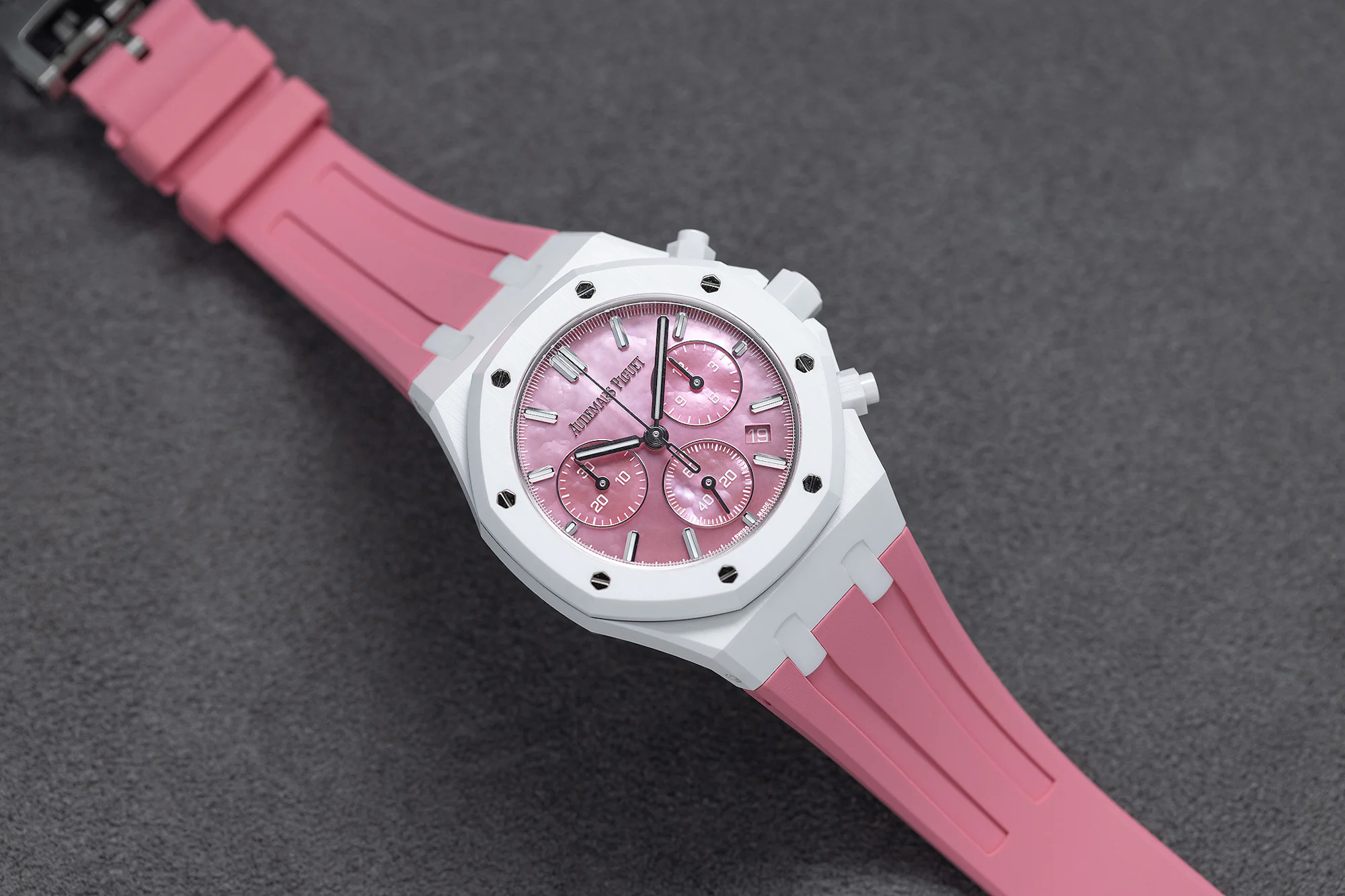
The watch also comes with a pink rubber strap.

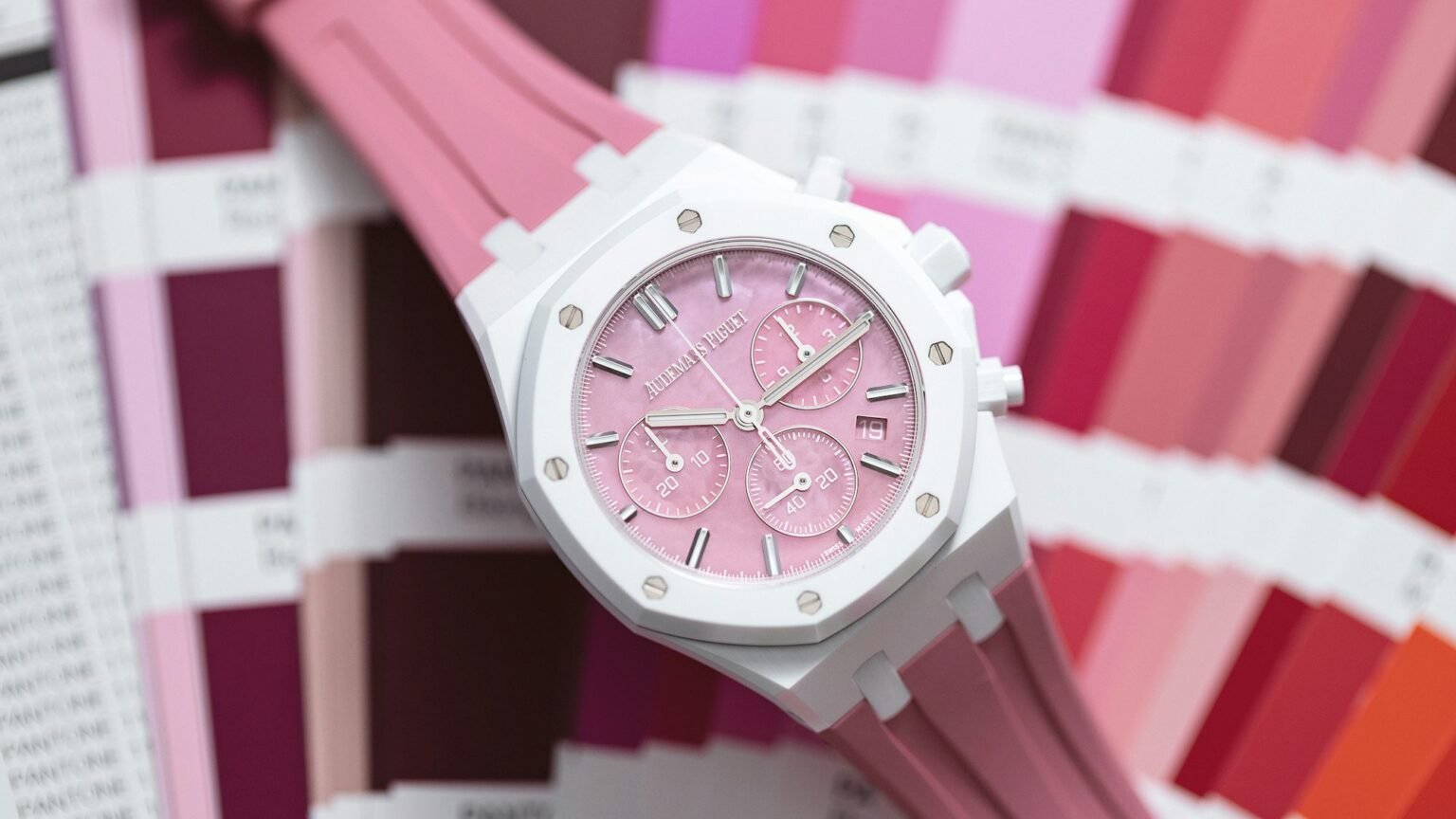
Williams’ connection with Audemars Piguet is longstanding. A partner of the brand for more than a decade, she has worn its watches on the court, on the red carpet, and everywhere in between. Now, for the first time, that relationship has resulted in a watch designed in collaboration with Williams herself: the Royal Oak Selfwinding Chronograph “Serena Williams” Limited Edition.
The 38mm Royal Oak Selfwinding Chronograph is rendered almost entirely in white ceramic, from the case and bezel to the crown and integrated bracelet, with a pink-tinted mother-of-pearl dial. Against the stark white ceramic, the dial has a soft iridescence, with white-gold hands and hour markers, rhodium-toned details around the chronograph counters, and a pink date window. It also comes with an additional pink rubber strap. It’s priced at CHF 70,000.


The combination of pink and white could easily have tipped into something saccharine. Instead, the ceramic gives the whole thing some muscle. It’s a useful tension because it is exactly the one Williams wanted to explore. “I’ve always believed that strength and feminine energy can exist side by side,” Williams says. “The white ceramic feels strong and resilient, while the pink mother-of-pearl dial brings warmth and softness. Every detail was intentional.” For Williams, the watch is a reminder that “you don’t have to choose between power and grace – you can embrace both.”
Inside is Calibre 6401, AP’s latest integrated self-winding chronograph movement, which replaces the Calibre 2385 that powered the brand’s more compact chronographs for nearly three decades. The new movement features an integrated column-wheel mechanism with a patented vertical-clutch system and offers a 55-hour power reserve. Through the sapphire caseback, you can see its 22-carat pink-gold oscillating weight. The watch is limited to 500 pieces.


The aesthetic itself has some precedent at AP. The pink mother-of-pearl dial recalls the ultra rare ’90s Royal Oak Perpetual Calendar ref. 25686RP, while the combination of rubber and diamonds recalls the Royal Oak Offshore ref. 25986 from 2003. The latter may be less en vogue today, but it remains an emblem of early-2000s excess and another expression of that same tension between something powerful and sporty and something deliberately precious.

Royal Oak Perpetual Calendar ref. 25686RP


A vintage ad for Audemars Piguet Ladies’ Royal Oak Offshore ref. 25986
More salient still is what the watch represents. Audemars Piguet is one of the few major watch brands to have pursued a considered women’s agenda, not by eschewing pink or diamonds, or pretending the only route to equality is making everything smaller, greyer, and more “genderless,” but by working with women, for women, and putting women in positions to define what matters to them when it comes to high-end watchmaking and luxury.


In recent years, AP has made a concerted, notably successful effort to speak to the self-purchasing woman, carving out spaces for women in the watch world that feel neither tokenistic nor like an afterthought. Williams, a woman who has spent her career defining the terms on which she wants to be seen, fits naturally into that story.
It makes sense that the woman who wore diamonds on court, even when they attracted criticism, would claim pink for her collaboration with the brand. Williams has never needed femininity to mean fragility. Pink doesn’t have to be coy. Diamonds don’t have to be delicate. Strength doesn’t have to be stripped of glamour in order to be taken seriously.


Perhaps Williams’ most powerful message was simply that women deserve to be seen. Her racket was one way of making that impossible to ignore. Fashion was another. Now, so is a pink Royal Oak.
For more, click here.