

Earlier this year, I had the opportunity to meet some of the team from Matador and was let in on a massive secret: Matador had plans to replace almost its entire line of soft goods. Unlike other manufacturers, this wouldn’t be a slow rollout or gradual discontinuation of lines; it was a hard stop, set for early August, almost an “end of an era,” if you will. Among the list of packs that were nearing their end was the GlobeRider line, which has become a regular in my rotation of bags. Thankfully, the Matador team had production samples on hand and was able to walk me through the changes and dispel my worries, and I’ve been putting one of these new models through its paces for about two months now.
Back in June of 2025, I took Matador’s GlobeRider 35-liter on an almost two-week-long trip to Atlanta and Alaska and was genuinely impressed by the bag’s performance. In my initial review, I mentioned that while being larger than I needed, the Globerider never felt out of place, whether I was using it for EDC, bringing home groceries, or hauling around a hefty bit of camera kit. Since then, I’ve taken the GR35 on a weekend trip to Paris, used it countless times to haul gear and groceries throughout the city, and it’s earned itself a constant place in my small but packed gear closet.


Having spent nearly two months with the new GTP, it has become clear to me that while this bag is something new, a significant amount of previous design DNA has remained. Most notably, the back panel/harness design resembles the GlobeRider series, with one notable change that I’m quite happy with. On the GlobeRider, the straps are attached at the bottom with a gated G-hook, which, while it worked, could be accidentally hooked the wrong way. Anyone want to guess how I found that out? On the new GTP, the straps are permanently attached at the bottom of the pack, with a buckle placed at the end of the padded section of the harness. While you could add a twist to the strap when it’s buckled, it’s not likely to awkwardly press against your side. As a whole, the straps can still be tucked behind the back panel, which features a built-in luggage passthrough strap, and the waist belt can be removed/wrapped around the bag when not in use. In addition, the GTP retains the hidden smuggler’s pocket in the same location, but it’s been widened, allowing for larger objects to be stored with better access. I really wouldn’t recommend putting anything bulky here, as you’ll feel it right against your spine.
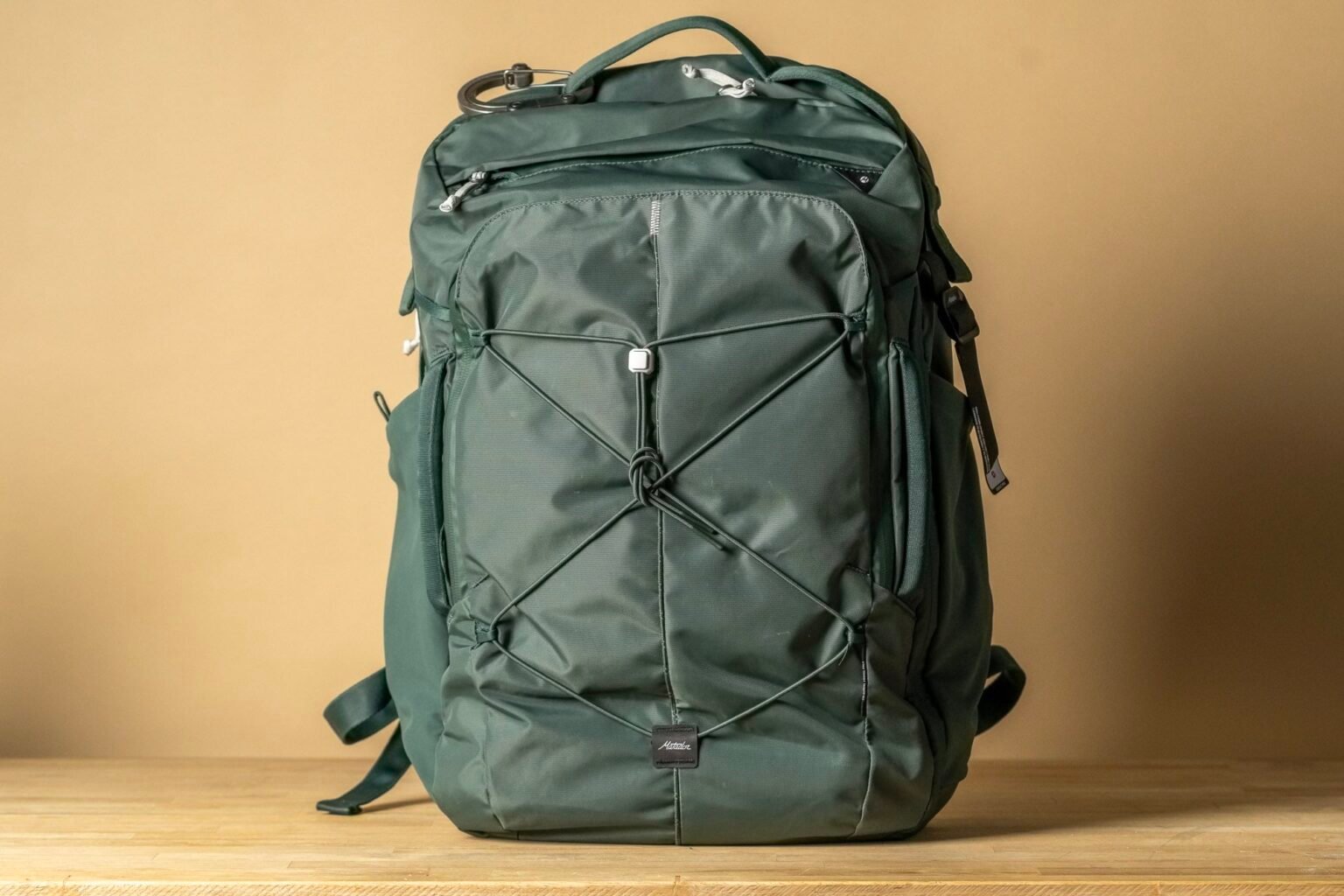
While these bags are still side by side, it’s worth noting just how different these packs truly look. The GlobeRider could be described as a very rectangular bag with a singular water bottle pocket and several grab handles positioned around the pack, while the newer GTP features a more rounded approach, additional grab handles, and dual water bottle pockets. Aside from the difference in overall shape, the most notable difference is that the GTP no longer has the front, stretchy kangaroo-style pocket that I loved so much on the GR35; it’s been replaced with an elastic shock cord. Unlike the kangaroo pocket, this elastic cord can be swapped out with Matador’s “Drip Kit”, AKA different colored shock cords to customize the aesthetics of your bag, or even removed altogether.

With this new design style, the entire layout of the GTP has changed; starting underneath the shock cord, the front admin pouch has been enlarged and now features a more useful layout of elastic and slip-style pockets, with several being large enough to fit a field note or passport. I personally found this new layout to be more useful than the previous, allowing me to tuck away my wallet/EDC items as I’d go through security. Within one of these pockets, there is a built-in “top secret” pocket for an AirTag, which is boldly labeled “insert location tracker here”. Above the admin pocket is a singular, horizontal zipper that’s semi-hidden, which reveals a quick-access pocket that’s similar in size and design to the top pocket on the GR35, although it’s been patterned in a way that allows it to slightly expand when you cram it full. In my day-to-day use, I often tuck my apartment/office keys in here, along with my badge and a pair of sunglasses; all things I want safely stored yet accessible.
Moving to the main compartment, the GTP features dual zippers that go about 330 degrees around the bag, allowing the bag to hinge fully open for packing/unpacking. On the lid flap, you’ll find a similar A, B, C pocket layout, with the bottom C pocket being the largest; the B pocket lives right behind the admin panel and can compete with it for space, while the A pocket is actually the top quick-access pocket from the front. That’s right, dual access into one pocket. At first, I wasn’t sure why this was done in such a manner, but I found myself using it to tuck an item away while I was packing, without having to flip the lid over. It’s a niche feature, but it has been handy at times. Just be sure to close the back side, or you might be fishing for items at the bottom of your pack. On the right side, there’s a luggage-style mesh flap that zips closed but opens inversely to the main lid. Everything else aside, this mesh flap has had the biggest impact on how I’ve used this pack over the last two months for both EDC and traveling.

With that said, the only true way to test this bag is by traveling with it, and it functions exceptionally well for that purpose. After all, that is what it’s designed for. Since I’ve had the bag, it’s accompanied me on two trips, on which I faced the dreaded but all too common issue with carry-on luggage. Given the frequency with which I find myself having to forfeit my carry-on when flying, I’ve begun traveling with an almost empty backpack that’s small enough that it can be crammed under a seat, yet large enough to safely house all of the electronics I often find myself traveling with. While the GTP is most certainly too big to be a personal item, it can fit under the seat, and I haven’t been stopped by airline staff for having a bag that was too big. As luck would have it, one leg of both of these trips was “fully booked,” and the airlines did their classic “we’ll be checking roller bags to your final destination” song and dance. In one fit of pre-boarding panic, I had the bright idea to try to fit the padded insert from my case into my bag, and it actually fit under the mesh flap, which then zipped over and secured all of my camera gear in place. I can’t say that I’d recommend this to anyone as a dedicated camera pack, but it functioned perfectly for the moment, and all of my gear made it into the plane without being placed below the cabin. Despite the friction it causes during everyday use, the mesh flap is actually extremely helpful in its intended purpose: keeping items you’ve packed inside the bag organized. In the case of someone who was packing mostly or only clothes, it would probably be perfect. Oh, and if you’re the kind of person who accidentally picks up an unzipped bag, this mesh layer just might prevent your clothes from getting slung around a room, or so I’d assume. I’ll admit to nothing.

While it might have been designed to be a “travel” pack, I’ve been using the GTP35 for my EDC backpack to get a better feel for this bag, and it was a rough start. Having been spoiled by the GR35 and its methods of accessing the main compartment, the mesh flap seemed like it was constantly in my way. If I zipped it fully closed, it seemed like I always left the zippers in the middle or at the bottom, never where I could easily access them from a partially opened bag. To combat this, I tried leaving the zippers undone and rolling/tucking the mesh flap inside the compartment. While this made reaching into the compartment easier, I found that the flap would flop around and sometimes get caught on jackets or larger items if I tried to remove them from a partially opened bag. While I could lay the bag down and fully open it at home or the office, I wouldn’t dare lay my bag down on the subway or a bus.

I will admit that the Global Travel Pack isn’t perfect by any means, and there are really three things that stick out to me. Despite being only marginally bigger (about 1” in height and width), the Global Travel Pack feels exceptionally larger than the GlobeRider. With the new design and curved nature of the pack, I expected it to actually feel smaller, but the pack takes on a “teardrop” shape when fully loaded that makes it look and feel larger. Secondly, the actual straps of the bag look visually cleaner with this new two-layer style, but you’re now limited to 4 preset chest strap locations, as opposed to the sliding rail system that was found on the GR35. While I was able to find a location that worked and felt good to me, I’d personally prefer the ability to minutely dial in the fit, and I have to imagine that some people might not find the perfect fit. Lastly, I’m just not a fan of the shock cord on the front of the pack. I should clarify that it’s not the difference in function between the kangaroo pocket and the shock cord, or that the cordage has gotten snagged on anything, but rather that the excess length of cordage just flops around, and there’s no clean way to manage it. I’ve personally tied the ends together around the woven section to prevent them from swaying around, but it’s just not as visually clean compared to the Kangaroo pocket.
Those few negatives aside, the Global Travel Pack is really an exceptionally well-built and laid out bag. Even when I’ve had it fully packed out, the pack didn’t feel exceptionally heavy due to the harness design, and the internal mesh compartment certainly helped prevent the zippers from sticking or binding as you operated them. It’s worth noting that Matador chose not to use YKK zippers this time around, but rather opted for Duraglide zippers that actually feel nicer and smoother than some other water-repellent models I’ve tried in the past. Matador does talk a bit about their decision for this change here, if that’s something you want to dig into in more detail. Zippers aside, I do greatly appreciate the inclusion of a secondary water bottle pocket and additional grab handles. I’d rarely carry two water bottles, but I do prefer to keep an umbrella in an external bottle pocket for quick access during those unexpected NYC summer rainstorms, and those additional grab handles make navigating a crowded subway car just a tad easier. Oh, I can’t forget to call out the new laptop compartment, which is entirely different. Rather than just a sleeve at the back of the main compartment, the GTP35 features a dedicated compartment with a suspended laptop sleeve on one side, and a smaller pocket that’s perfect for an iPad mini or a Kindle. Matador says this compartment will fit laptops of all sizes, and judging by how much room is left when I dropped in a 16” MacBook Pro, I feel confident they are telling the truth. If someone finds a laptop that doesn’t fit, please let me know.

I’ll admit that I was quite shocked when I learned of Matador’s decision to discontinue an entire line of packs at once, especially ones that appeared to be so successful from the outside. However, digging into the intent of the redesign begins to put everything in perspective. I have to give Matador credit here; they don’t try to hide their intentions or spin it with clever marketing; they straight up own it and lay it all out in the open. While they dive into great detail in a recent blog post, I feel that it could be accurately summed up in the following lines:
“The safer path would have been to keep improving one bag at a time. The harder path was to step back, rethink everything together, and build the collection we wished we’d had from the beginning. So that’s what we did. Over the last three years, our team rebuilt the entire lineup from the ground up — not as individual products, but as one connected system.”

Now that I have a considerable amount of time strapped to the GTP35 and briefly intersecting with additional products that were part of this design, it feels like they did what they set out to do. Each pack feels individually useful, while also pairing with additional models to create a carry ecosystem instead of just crafting a carry solution.
At the end of the day, I have to say that the GTP35 is one I would recommend people check out, especially if they’re looking for a dedicated travel pack. Despite the initial learning curve and adapting to how the pack was designed, it never let me down when it came to capacity or how it handled a heavy load. Sure, a waist belt might look a little dorky in the moment, but it does make a massive difference at the end of a long travel day. Just like the GR35, the hip belt can always be removed, and it’s even easier to remove now, a welcome upgrade for those early morning panic packing sessions. Even though I rarely found myself using the pack exactly as it was intended as a one-bag travel pack, I can certainly see it being utilized for future travel plans, just ones where I don’t need to bring an entire photo studio along for the ride. Matador
The post Review: the Matador 35L Global Travel Pack appeared first on Worn & Wound.