

Vintage Seiko, as most collectors know, is a rich tapestry. Once you learn the story of Colonel William Pogue, or try to track down the funky bracelet that Bruce Lee paired with his own Speed-Timer, the wormholes naturally open themselves, each with their own dizzying amounts of reference numbers, specific models, and fun nicknames for the mind to notice and then squirrel away for later.
But what about the ones you might have overlooked? Midcentury Seiko chronographs are a riot of design variations, bold patterns, and contrasting color schemes—and all backed by genuine innovation in the guise of the first automatic chronograph, flyback movements with stacked register hands, collaborations with luminary designers, and freakish dabbles with postmodernism. It’s what makes them so much fun to pay attention to.
Hence, these six Seiko chronographs that play with the form, proving that even across the decades there are still surprises to rediscover. Not just familiar references, but obscure offshoots.
Seiko 6138-8000 “Baby Panda”
Seiko’s dual-register chronograph debuted shortly after the 6139, which we all know as the world’s first automatic chronograph. And while both watches represent futuristic seventies design, the slimmer 6139 takes a backseat to this lineup’s exaggeratedly bulky cases and clashing, patterned color schemes that have garnered nicknames like “UFO,” “Kakume” (“square eyes”), and “John Player Special” (a nickname popularized by Worn & Wound alum Sean Lorentzen).

Image via Reddit
By those standards, the classic black-and-white “panda” scheme might seem boring. Yet, when it’s paired with a sharp case with smaller proportions, the 6138-8000 “Baby Panda” gives the series much-needed sophistication. Its rarity is also the point: sold only in Japan for two years, alongside an even harder to find “reverse panda” with a radiant charcoal-gray dial, it’s shown that finding certain vintage Seikos can prove to be big bucks.
Seiko 6139-7012 Speed-Timer “JASDF”
The impact of the world’s first automatic chronograph was immense: astronauts, Formula One drivers, yachtsmen, and action heroes had a Seiko 6139 strapped to their wrists. And for a few short years during the 1970s, so too did certain pilots of the Japan Air Self-Defense Force. The version used by the JASDF replaces baton indices with practical Arabic numbers, set against a contrasting black dial; while this variation was also sold to civilians, the differing mark was on the caseback, stamped with JASDF’s cherry blossom insignia and an individual military personnel number. According to our friends at DC Vintage Watches, members of the JASDF Blue Impulse demo team prominently wore Speed-Timers while flying their F-86 Sabres.

Image via DC Vintage Watches
Decades later, another Seiko chronograph would become standard kit for another air force: Great Britain, almost singlehandedly keeping the tradition of military-issue watches alive throughout the 20th century, ensured that nearly every RAF pilot wore a Seiko 7A28 chronograph.
Seiko 7016-5000 “Monaco”

Image via Musings of a Watch Addict
In the Daini vs. Suwa internal rivalry that defined midcentury Seiko, the 70xx series was a shot across the bow: a technological marvel from the Daini factory against Suwa’s 6139. It is a true flyback chronograph, with quickset day-date, a single register with stacked hands, and a fully automatic movement—all within a package less than 40mm, and just 5.9mm tall. The 6139 was the first automatic chronograph in 1969, and two years later, the 7018 became the smallest automatic chronograph, a record it held for over a decade. Most watches in the series feature a svelte round case with gently tapering lugs and hard-edged facets, not unlike Grand Seiko’s “grammar of design” in the same era. Yet out of all the variations, the aptly-named “Monaco” makes for a great introduction: its puffy “squircle” case is shaped like a marshmallow, a form that echoes in the ridged bezel and contrasting center-seconds dial. The coolest visual element: the sunray lines at the edge of the dial, intersecting with the railroad track. It’s something even Heuer devotees can appreciate.
Seiko 7A28-5000 “Steering Wheel”
The first quartz chronograph lent itself to one of the greatest collaborations in the watch world: between Seiko and Giorgetto Giugiaro, the Car Designer of the Century. Giugiaro, operating in an automotive industry that was then obsessed with clean-sheet ergonomics, combined function-over-form practicality with a healthy dose of futurism.

Image via Reddit
And among the half-dozen watches that Giugiaro created for Seiko, the 7A28-5000 “Steering Wheel” is the wildest and rarest one yet: dark green and pill-shaped, with pushers moved to the corners and a black plastic ring rising upwards like the railing around a boat’s prow, jutting out in defense of the watch. Ergonomics and safety interpreted in forms never previously seen before, and therefore seen as futuristic.
Seiko 5718-8000 “Counter Chrono”
Chances are you’re familiar with the Crown chronograph monopusher made for the 1964 Tokyo Olympics, and a milestone—Seiko’s first-ever chronograph. Yet, In the midst of a full-scale engineering effort that encompassed electronic timing components, chronometers, marathon clocks, and printers, Seiko produced another chronograph for the Games, one absurdly rare by comparison. The 5718 “Counter Chronograph” features a modification of the 5179’s base caliber. But atop this was the piece de resistance: a complex date function consisting of a two-digit date counter in square windows, each digit controllable by its individual pusher. Positioned atop a small-seconds register with stacked hands, and against a beautiful sunburst gray or silver dial, the overall design is beautifully considered and never too busy, even against dual railroad tracks (delicate light blue numbers for the tachymeter is a nice touch).

Just 100 examples were produced, each with a retail price more than a Rolex Submariner. It was only sold for the two-week duration of the Olympics, and could only be found at the Olympic Village. A combination of historical significance, engineering ambition, and unicorn status makes it a Grail-worthy Seiko.
Seiko Sportura Kinetic Chronograph SLQ011
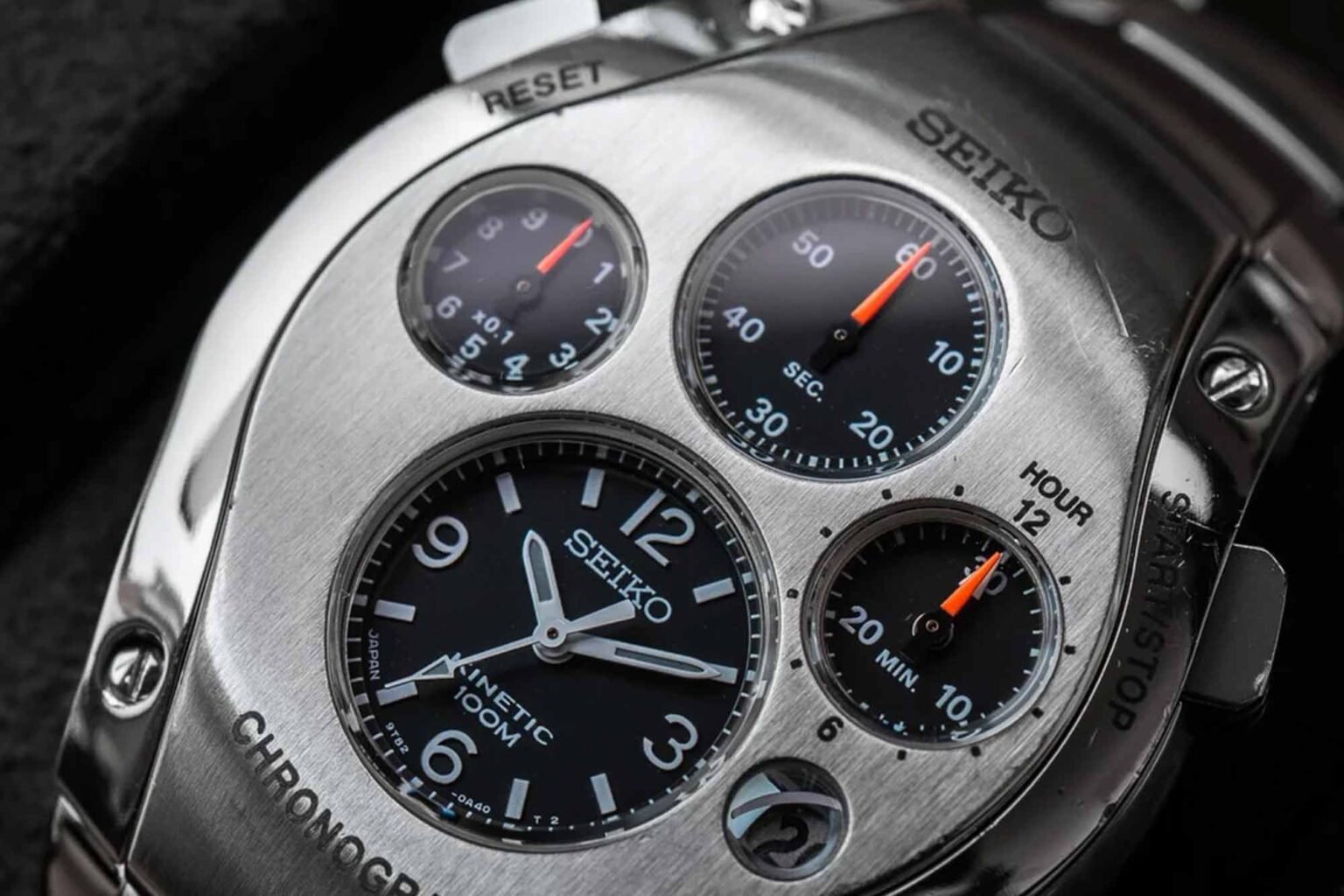
Here’s one for real Nineties kids. This millennium-era oddball separates each chronograph subdial into its own little black-dial circle, nestled within a solid chunk of titanium shaped like a pear and slightly reminiscent of The Iron Giant’s visage. Exposed screws, an integrated curving bracelet, and even a little white date window—sticking out on the right side like a pimple—give it a brutalist bent. The SLQ011 was one of the rare times that Seiko’s Kinetic system was employed for a chronograph: it combines the motion of an automatic rotor with an electric capacitor and quartz movement, almost like a Spring Drive on the cheap. The Sportura line may have debuted in the year 2000, but it’s thoroughly out of the aesthetics of the decade before, able to complement an era of rave pants, mesh crop-top shirts, and Rollerblades. Hack the planet!
The post Six From Seiko: A Roundup of Amazing Chronographs From the Depths of (Relative) Obscurity appeared first on Worn & Wound.