

When Vacheron Constantin announced the original Twin-Beat at SIHH in 2019, I wasn’t in the watch space in the same way I am now. I was also focused on a much different price point—the one I shop in, not the one that I’ve since become fascinated by. So I missed it. A lot of people did, it seems. I don’t think this watch, as interesting as it is/was as a first release, was made in particularly large numbers, and for over a year, I heard rumblings about the eventual return of the Twin-Beat. Well, it’s here. It’s improved. And yes, in the metal, it’s both entertaining and impressive. But what is it?
Essentially, the watch leverages two balances that beat at different rates to provide either 4 days of power reserve running at 5Hz or 70 days in standby mode at 1.2Hz. Oh, and it’s a perpetual calendar as well. We covered the technical aspects back in 2019, so this will focus more on the watch as a revived model.

The technical is the key here, but the form factor is impressive as well. A perpetual calendar, with dual balances, measuring 42mm and 12.3mm thick, it’s hefty because of the platinum case, but it wears quite well despite the technicality. Vacheron has a tendency to make some impressively complicated watches and, unfortunately, make them quite large in the process. This would never have been a problem in the old days (especially for brands like Patek, which dominated this high-end, integrated complication space), but then again, the specifications of the old days don’t meet modern standards.

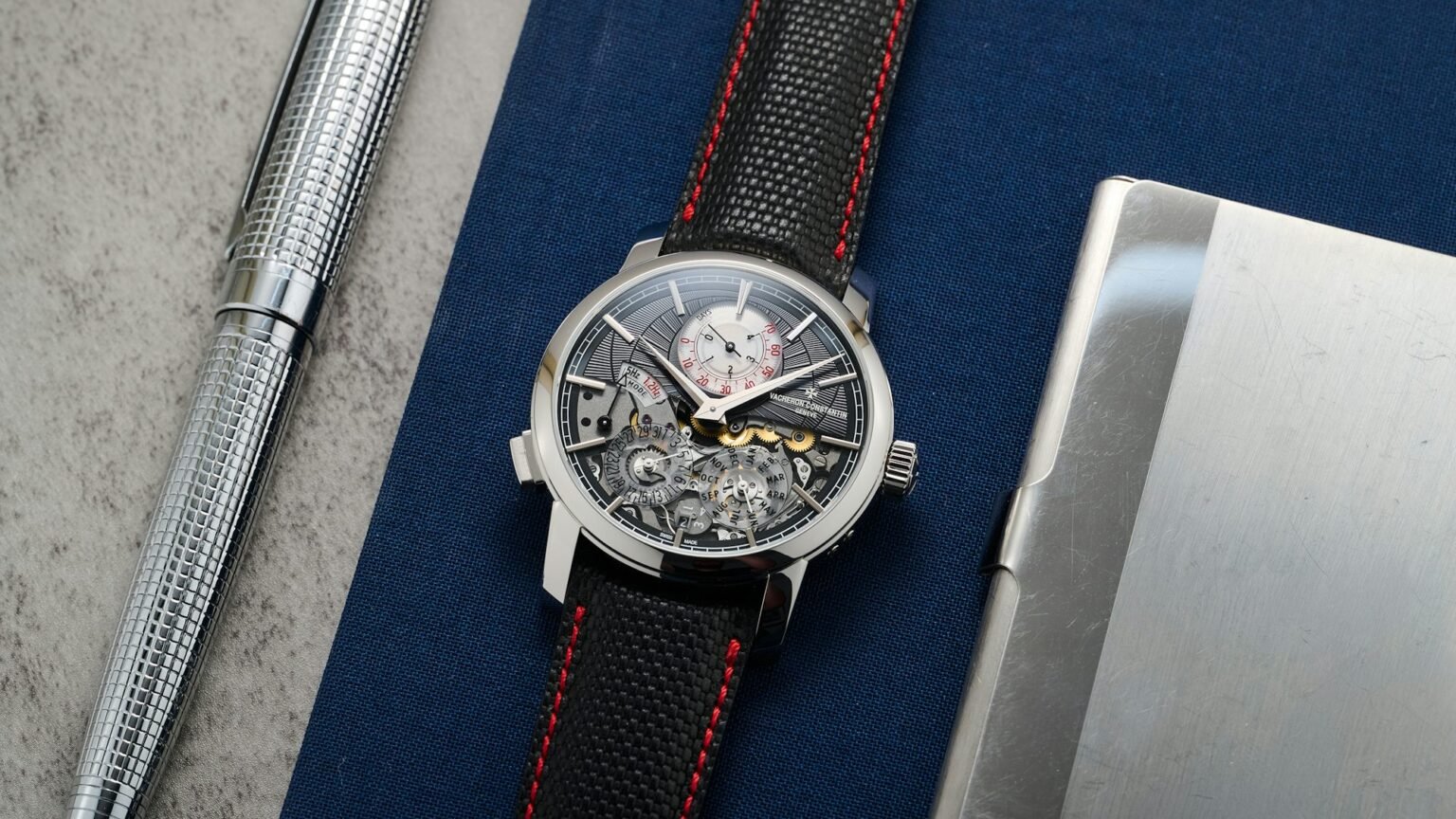
Vacheron has done a good job highlighting the technicality of the watch from the front while still making it legible. And, in addition to the technical improvements that we’ll get to, there are some subtle visual changes from the first iteration. Though frankly, without both the new and old in front of me, I had to ask Vacheron to explain those details. The dial guilloché is slightly darker, and the subdials are said to be more frosted and therefore more legible. The helpful PR person at the brand said that it’s all in service of legibility, which the watch surprisingly does pretty well at despite being half open-dialed.

Straight on, you’ve got most of the indicators you’d find on any perpetual calendar. No, there’s no day of the week, which is helpful if you’re someone who is, say, writing this story on a Sunday because you’re trying to get ahead of work but need a reminder that it’s not Monday and you should probably be watching TV. A hypothetical, of course. The month, date, and leap year indications are really legible and just seem to be floating over the dial side movement without any support.

Viewed at a bit of an angle and you can see the sapphire dial that supports the displays and the window for the leap year. You can also see the frosted finishing for the plates and the chamfering done, which looks quite nice even if it’s not artisinal “Independent-level” work. But the most important thing about the visual is that the polished dauphine hands really stand out despite how busy the dial could potentially be.

At 9:15 on the dial and at the top at 12 o’clock are the two signs that there’s something a bit more interesting going on. The left side indicates the mode that the watch is in, between the two balances used. The top subdial shows the two potential power reserves, depending on the mode (active or standby). Even at four days of power reserve, it’s a pretty impressive perpetual calendar. Setting a perpetual calendar is always a pain, but with 70 days (up from 65 in the previous model) of power reserve in standby mode, the Twin Beat is actually potentially the most user-friendly perpetual calendar on the market.

At the rear, you can see how the magic happens. Let’s start at the top. As pointed out in our story back in 2019, the brand has two mainsprings, but housed inside one barrel. Each mainspring is responsible for one of the two gear trains, so essentially the watch is two watches in one, with a differential allowing one to start and the other to stop with a minimal (imperceptible) pause during the switch. Meanwhile, a differential allows both mainsprings to continue to unwind even if one of the trains is stopped.

In the lower half of the movement, you can see the two balances. Neither is free-sprung. You can see that because the beat rate is slower on the right balance, at 1.2Hz, it’s much larger than that of the 5Hz standard balance. Because of the large inertia for that 1.2Hz movement, the brand has used a finer gauge wire for the hairspring and has a purple silicon escape wheel. In the photo below, you can see the mode selector brakes have rocked over to the right, stopping the 1.2Hz balance and allowing the 5Hz to run freely. The anthracite bridges (with a few interior angles) have a futuristic look that stands out from standard Holy Trinity finishing.


There’s actually a lot to look at on the rear, especially if you switch back and forth between the modes while watching the system at work. Again, I refer back to our previous story, which has illustrations of the functions and how they’re accomplished. Beyond the aesthetics, it was a well-known fact among collectors that, despite the awesome concept, the watch had a bit of a teething issue with functionality. It just wasn’t all that reliable, which is why Vacheron chose to relaunch. Those issues should all be gone, and the power reserve is now higher in standby.

Generally, the entire thing is a seamless experience once running. However, I did get the sample watch basically fresh out of the box and the watch had no power in it. So after winding, and winding, and winding some more, I got the watch started. But the balance wouldn’t run at 1.2Hz. It turns out I was only at 1 day of power, so I kept winding. It seemed that the watch needed a bit more than a day’s worth of power to get the 1.2Hz balance to switch over, but then it stayed running perfectly fine. After that I quite enjoyed wearing it.


The Competition
Let’s be clear: there’s really nothing like this on the market. The double-balance approach that VC has taken is novel—rather than being a quirk or a chronometric tool like other brands, it functions basically like a standby mode. Adding on a perpetual calendar then puts it even further out of context compared to any other watch. Competition, therefore, is pretty abstract. So let’s break it down into parts in the abstract, all the same.
Philippe Dufour Duality, F.P. Journe Chronomètre à Résonance, and Greubel Forsey Double Balancier

A Philippe Dufour Duality that immediately looks far different than its successor, the Simplicity.
These three watches all feature two balances but don’t approach the concept in the same way (or attempt the same result) as the Twin Beat. Dufour’s Duality was the first double-balance wristwatch when it was introduced in 1996 for CHF 95,000 (or about $150,000 at the time). The watch uses a mechanical differential to average the beat rate of two different balances in one watch, theoretically providing more chronometric precision, and, with only 9 made, the watch now sells around $3 million when the rare example appears at auction. The Greubel Forsey Double Balancier (with its first six-piece limited edition released in 2011 for CHF 390,000) takes the same concept, adds a spherical differential, and inclines the balances. Neither has a particularly long power reserve, but again, they are trying to accomplish different things.

The Greubel Forsey Double Balancier Convexe
The core raison d’être of the F.P.Journe Chronomètre à Résonance is to serve as a proof of concept. Chronometric precision is achieved through two closely regulated balances that average their beat rates via the concept of “resonance.” The most recent version of the watch does add a remontoir differential, but that wasn’t a cornerstone at the beginning. The retail price is also more reasonable—south of $200,000. But then again, it’s really hard to get one at retail. And none of the above watches attempt to accomplish what the Vacheron does. But it’s interesting how the concept of a differential has been used differently by brands, especially Vacheron, for the mainspring.

The double balance approach of the F.P. Journe Chronomètre à Résonance.
Breguet Tradition Chronographe Indépendant 7077

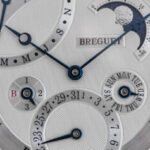
This time, we have a watch, originally released in 2015, that has two balances running at two different beat rates (3Hz and 5Hz), yet again solving a different issue. Putting a chronograph inside a watch comes with an inherent problem. The activation of the chronograph causes a small drop in amplitude as the mechanism shifts into gear, so to speak. So Breguet created a watch with two balances and two gear trains, running the two parts of the watch. And that’s not all: the chronograph is powered by a blade spring. You can read all about it here. Understandably, then, the watch is massive—44mm by 14.1mm with a 48.7mm lug-to-lug—which makes a creative solution a bit inelegant. Readability is a bit of a challenge. But there’s an argument to be made that if you own the Twin Beat for the perpetual calendar, the ref. 7077 is a fair complement. There’s a more recent version with a revised color treatment that retails for about $125,000.
Hublot MP05 LaFerrari and F.P. Journe élégante
There were a number of watches I could have picked for this last slot, where I focused on power reserve. You could argue for the IWC Big Pilot Perpetual Calendars (7 days), the Lange 31, and the new Panerai Luminor 31 Giorni (both with 31 days). However, the Hublot MP05 LaFerrari from 2013 is, as far as I know, the only watch with a power reserve that comes close to the Twin Beat. It’s a massive, aggressively styled watch with 11 barrels and a 50-day power reserve. The included winder is essentially a wheel gun. There’s a power reserve indicator and a rotating digital display. Oh, and a vertically-mounted tourbillon. At release in 2013, it cost about one-third the price of the car itself at around $300,000. Now, you can pick up one of the various options (including an Aperta version with a sapphire case) for around half the price or less.

A later version of the Hublot MP05 LaFerrari with diamond-set case. Photo courtesy Bonhams.
Then there’s the élégante. Am I mentioning this to be a bit of a troll? Maybe. Is there a comparison to be made? Also maybe. The élégante is one of the hottest watches on the market at the moment, but the 48mm version in Titalyt retails for about $22,000. It’s also nearly impossible to get in the next decade, and the brand isn’t taking any more wishlist requests for the watch, so the price achieved at a recent Phillips auction was ten times that amount.

The F.P. Journe élégante that sold for over $235,000 earlier this year. Photo courtesy of Phillips.
The comparison here is that the watch has a long (8 to 10 years) power reserve. Not hard to do since it’s a quartz watch, sure, but like, the 1.2Hz balance of the Twin Beat gives you a “Standby” mode; the élégante has its own standby mode, and if left untouched, the watch will run for up to 18 years. So if you’re the kind of person who wants to spend a lot of money and then not touch your watch for a long time—longer than the 70 days between Twin Beat wears—then the élégante is for you. Or you could just wear your watch more often than once every 18 years.
Final Thoughts
This wasn’t my first experience with a Twin Beat, but it was my first with this version, and I was impressed, but in an interesting way. The watch is incredibly cool, yet somehow subtle. It does everything it promises in a really great package, and while the technicality comes through visually, it’s somehow measured as well. The case shape is at least more interesting than what a lot of independents are doing these days (the young ones tend to feel generic and similar to each other). It’s also a bit confidence-building that the brand decided not to push forward with a version of a cool concept that didn’t work as well as intended—another benefit of buying from a large brand.

It’s far from a daily-wearing watch—30m of water resistance and a price tag that’s rumored over $350,000—but the whole point of the “standby mode” is that you don’t need to wear the watch every day. Is it sexy enough to supplant the Overseas for a general consumer? Probably not, but it’s probably the most successful demonstration of Vacheron’s skill with high complications, partially because it’s their most wearable.